

Why Most Nigerian Speakers Lose Their Audience in the First Two Minutes — And Don’t Know It
By Ubong Essien, CSP
Dean, School of Eloquence
West Africa’s Only Certified Speaking Professional
Author, Speak with Power
Let me say something uncomfortable.
Most speakers in Nigeria do not lose their audience halfway through their speech.
They lose them in the first two minutes.
And they do not even know it.
The audience may still be seated.
They may still be looking at you.
But mentally? They have left.
Why?
Because the speaker is static.
You Are Not Boring. You Are Static.
There is a difference.
Many professionals believe they are being “calm” or “composed.”
What they are actually being is flat.
Flat voice.
Flat face.
Flat body.
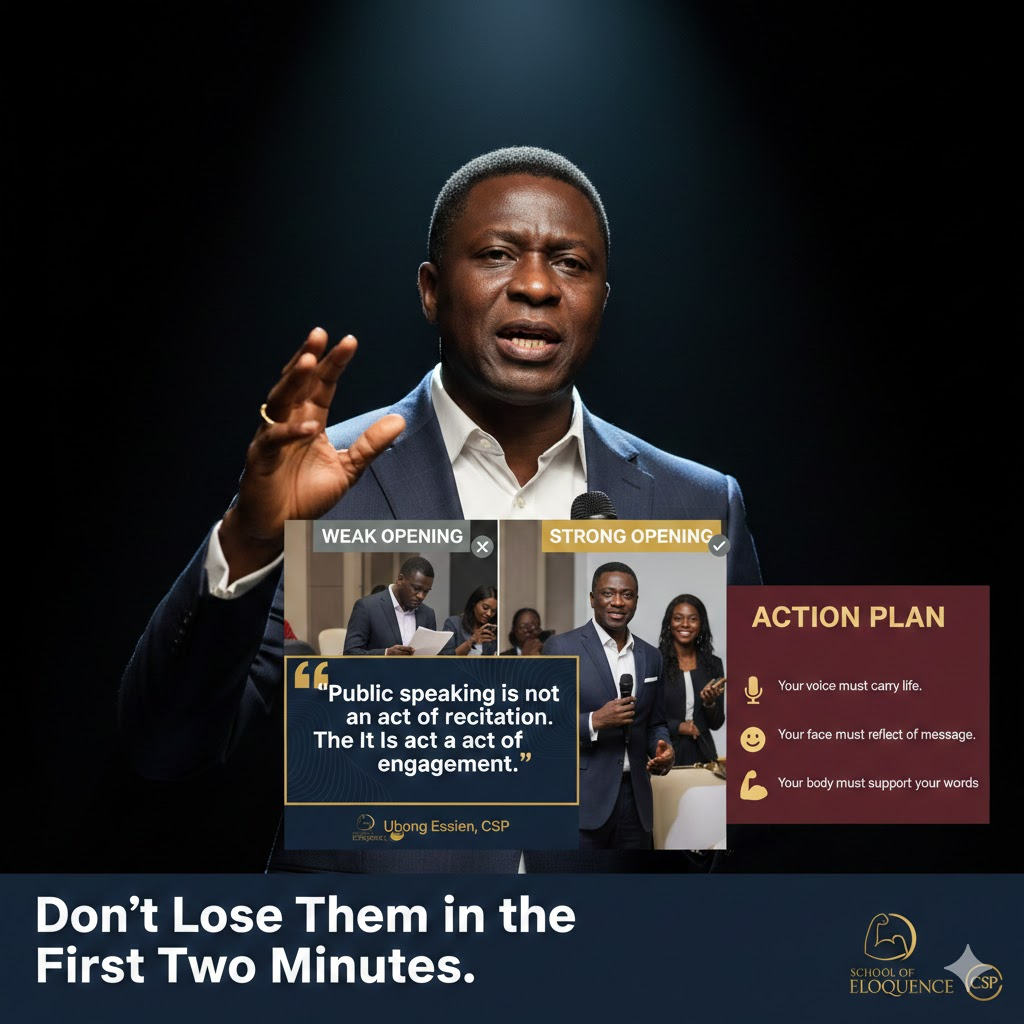
Public speaking is not an act of recitation. It is an act of engagement.
If there is no life in your delivery, there will be no life in the room.
Speaking Is Not Isolation. It Is Engagement.
The moment you stand to speak, something shifts.
You are no longer thinking about yourself.
You are thinking about:
- How do I pull them in?
- How do I make this matter?
- How do I move them?
If you approach speaking as “let me just say what I have prepared,” you will fail quietly.
But if you approach it as “let me engage these people,” everything changes.
Your voice becomes intentional.
Your gestures become descriptive.
Your face becomes expressive.
Energy rises.
And when energy rises, attention follows.
The First Two Minutes Decide Everything
The opening moments of your speech determine whether the audience leans forward or leans back.
Weak opening:
- Low energy
- Reading from paper
- No eye contact
- No variation in voice
Strong opening:
- Clear projection
- Controlled pauses
- Engaged eye contact
- Immediate presence
You cannot afford to “warm up slowly.”
You must enter strong.
The Hard Truth
If your audience checks their phone within two minutes of you starting, it is not because they are rude.
It is because you gave them no reason to stay.
That is not cruelty. That is reality.
Public speaking is competitive.
You are competing with attention spans, notifications, fatigue, and distraction.
You must win quickly.
What To Do Instead
When you stand up to speak, remember three things:
- Your voice must carry life.
- Your face must reflect your message.
- Your body must support your words.
Do not wait until halfway through your speech to “come alive.”
Start alive.
Because once the audience mentally leaves, it is extremely difficult to bring them back.
If you want to master the discipline of engaging from the first minute, that is exactly what we teach inside the School of Eloquence Masterclass.
Speaking is not about talking.
It is about commanding attention.
And that is a skill.
Stay in the loop