

Public Speaking Is Not Talking. It Is Engagement.
By Ubong Essien, CSP
Dean, School of Eloquence
West Africa’s Only Certified Speaking Professional
Author, Speak with Power
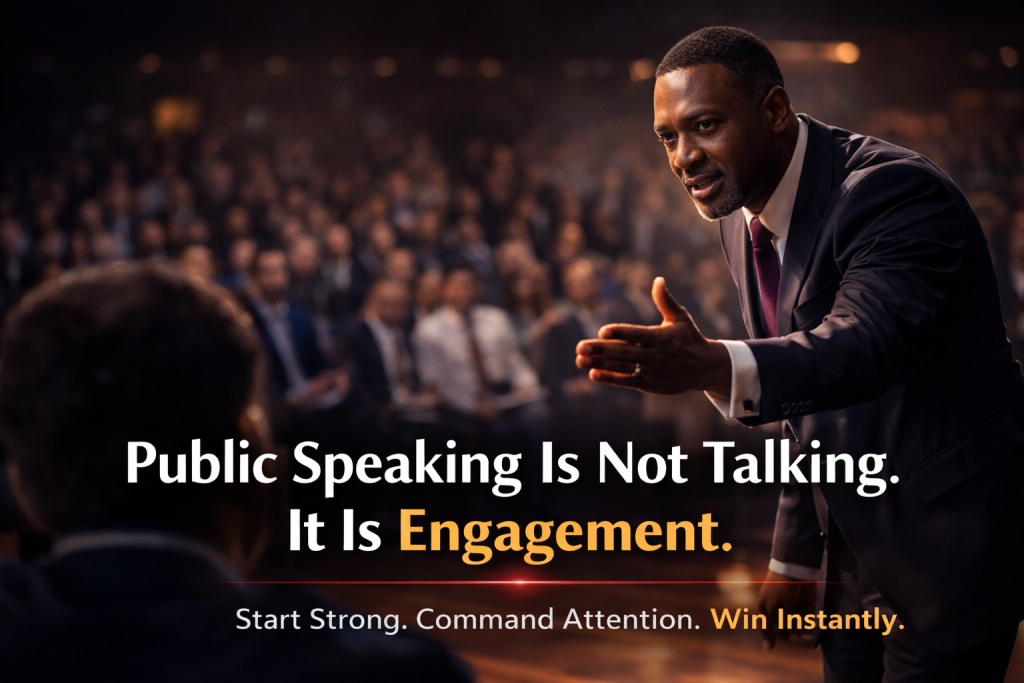
Let us correct a dangerous misconception.
Public speaking is not talking.
Talking is what you do with a friend over coffee.
Talking is what you do on the phone.
Talking is informal.
Public speaking is engagement.
And engagement requires intention.
When you stand before an audience, something changes.
You are no longer participating in a casual exchange.
You are leading attention.
And leadership demands control.
Talking Is Passive. Engagement Is Active.
Talking assumes the listener will follow.
Engagement earns the listener’s attention.
Many professionals make this mistake.
They stand before an audience and simply “say what they have to say.”
They assume that because the audience is seated, they are engaged.
Seated does not mean engaged.
Silent does not mean interested.
Still does not mean attentive.
Engagement must be created deliberately.
Engagement Has Three Components
If speaking is engagement, then what creates it?
Three things:
- Direction
- Energy
- Responsiveness
Direction
You must know where you are taking the audience.
Every sentence should feel purposeful.
If your thoughts wander, your audience will wander faster.
Energy
Energy does not mean shouting.
It means vocal life.
It means facial alignment.
It means controlled gesture.
Energy keeps attention awake.
Responsiveness
You must read the room.
Are they confused?
Are they drifting?
Are they reacting?
Public speaking is not robotic delivery.
It is adaptive leadership.
Why Engagement Changes Authority
When a speaker is merely talking, authority feels distant.
When a speaker is engaging, authority feels grounded.
The audience senses:
“This person sees us.”
“This person is connected.”
“This person is leading us.”
That shift transforms perception.
And perception determines influence.
The Professional Standard
Serious speakers never “just talk.”
They:
- Project intentionally.
- Pause strategically.
- Vary their pace.
- Maintain eye contact.
- Adjust based on response.
They are present.
Presence is engagement.
And engagement is power.
The Hard Truth
If you believe your job is simply to deliver information, you will lose rooms consistently.
Information does not command attention.
Engagement does.
Public speaking is not about filling silence.
It is about directing focus.
And that requires skill.
Inside the School of Eloquence, we train speakers to move from passive talking to active engagement.
Because once you understand that public speaking is leadership in real time, your entire approach changes.
You stop speaking at people.
You start moving them.
Stay in the loop