

Why Most Political Interviews Go Wrong in the First Three Minutes
By Ubong Essien, CSP
Dean, School of Eloquence
West Africa’s Only Certified Speaking Professional
Author, Speak with Power
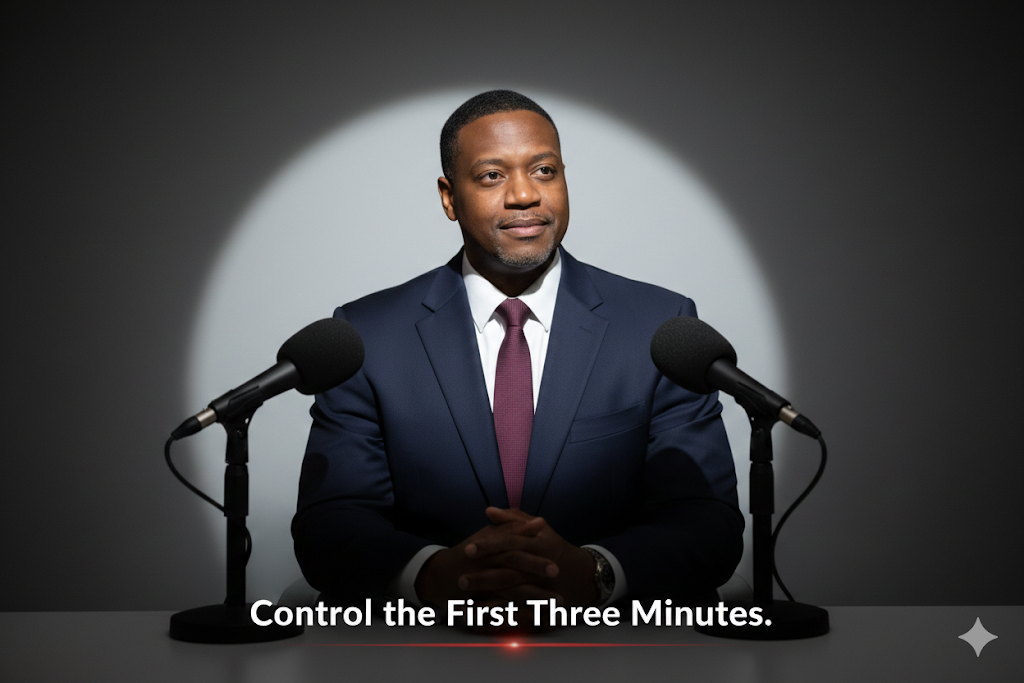
Let me be blunt.
Most political interviews do not collapse halfway.
They collapse at the beginning.
In the first three minutes, you either:
- Establish control
- Or surrender it
There is no middle ground.
The First Answer Sets the Frame
Journalists test you immediately.
The first question is rarely casual.
It is strategic.
It is designed to:
- Frame the narrative
- Provoke emotion
- Expose weakness
- Force defensiveness
If your first response is long, scattered, or emotional, you have already lost positioning.
Control is not about avoiding tough questions.
It is about framing your response deliberately.
Emotion Is the Fastest Way to Lose Authority
Under pressure, many public figures do one of three things:
- Become defensive
- Become verbose
- Become confrontational
All three weaken authority.
Calm delivery signals strength.
Measured pacing signals preparation.
Concise answers signal discipline.
Authority is emotional control under scrutiny.
Do Not Surrender the Narrative
Many interviewees answer the question exactly as framed.
That is naïve.
You must understand:
The question is a doorway.
Your answer determines the direction.
Professional communicators:
- Acknowledge the question
- Reframe strategically
- Deliver a structured response
- Bridge back to core message
If you do not steer the conversation, the interviewer will.
Brevity Is Strategic Power
Long answers feel insecure.
Short, structured answers feel confident.
A powerful interview response often contains:
- A clear position
- A key supporting point
- A forward-looking statement
Nothing more.
Discipline is persuasive.
The Hard Truth
If you prepare talking points but fail to prepare your delivery discipline, you will struggle on live media.
Interviews are not debates.
They are perception moments.
And perception forms quickly.
Inside the School of Eloquence advanced communication coaching, we train leaders to control narrative without appearing evasive.
Because in high-stakes interviews, you are not just speaking.
You are positioning.
And positioning determines influence.
Stay in the loop